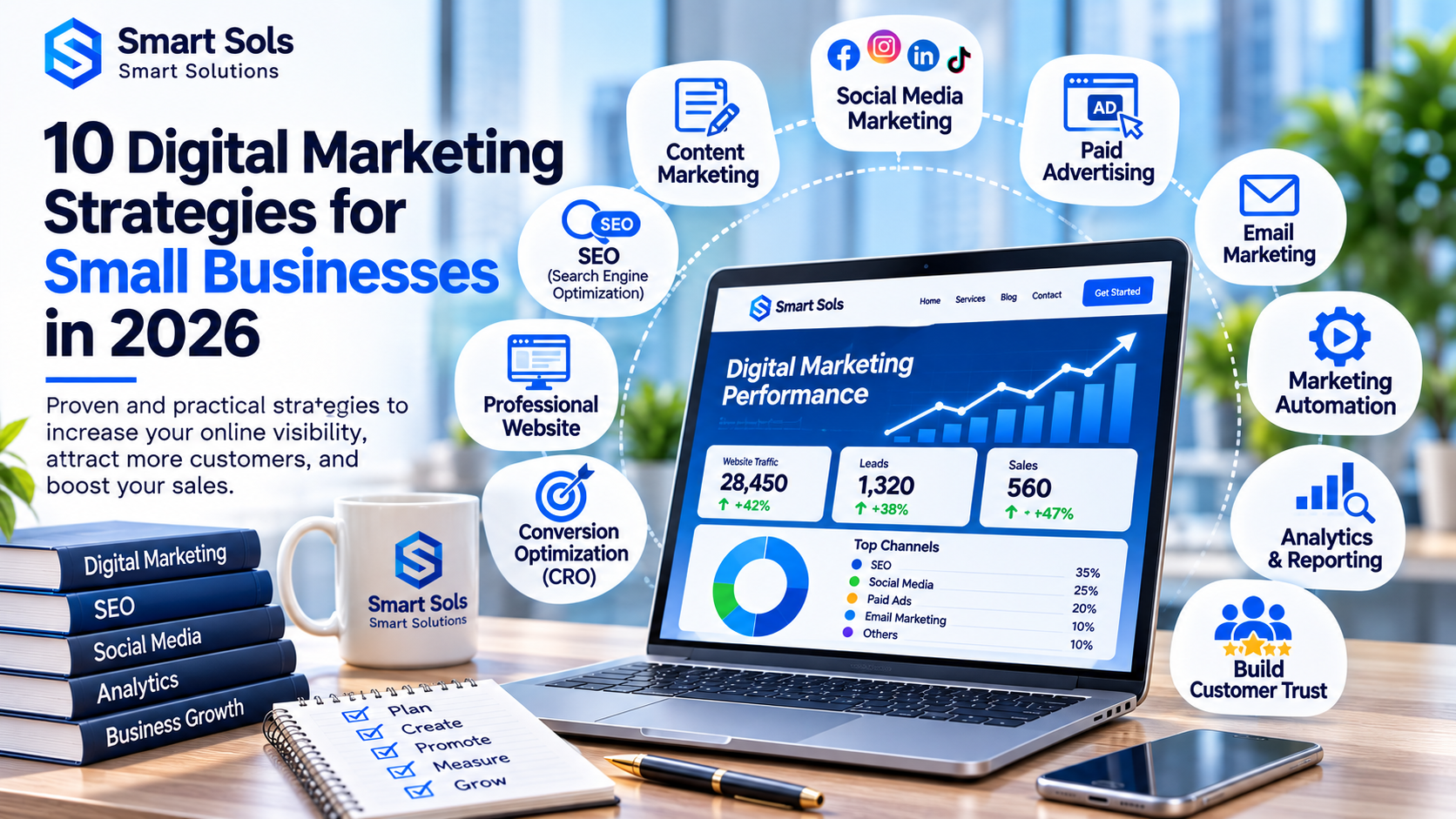
Digital marketing has become an essential part of growing a successful business. In 2026, small businesses have more opportunities than ever to reach potential customers through search engines, social media, websites, and digital advertising. However, choosing the right marketing strategies can be challenging when budgets and resources are limited. In this guide, we explore 10 practical digital marketing strategies that can help small businesses improve online visibility, attract qualified leads, build customer trust, and achieve sustainable growth.
10 Digital Marketing Strategies Every Small Business Should Know in 2026
Digital marketing is no longer an optional activity for businesses that want to grow. Customers increasingly use online channels to discover products, compare services, research companies, and make purchasing decisions.
For small businesses, digital marketing creates opportunities to compete for customer attention without requiring the same resources as large corporations.
However, successful marketing is not simply about posting on social media or spending money on advertisements. It requires clear goals, a strong digital presence, an understanding of your audience, and continuous performance measurement.
In this guide, we explore 10 practical digital marketing strategies that can help small businesses attract customers and build sustainable growth.
1. Build a Professional and Conversion-Focused Website
Your website is the foundation of your digital marketing strategy.
Social media platforms can help you reach customers, but your website provides a central location where visitors can learn about your company, explore your services, and take action.
A professional website should include:
- Clear information about your products and services.
- Modern, responsive design.
- Fast loading performance.
- Easy navigation.
- Visible contact information.
- Strong calls-to-action.
- Authentic customer testimonials.
- Search engine optimization fundamentals.
Why Website Design Matters
A poorly designed website can reduce customer trust and discourage visitors from making inquiries.
For example, a potential customer who clicks on an advertisement should immediately understand what your business offers and how to contact you.
A well-structured website supports your advertising, content marketing, and lead generation efforts.
2. Invest in Search Engine Optimization (SEO)
Search Engine Optimization helps search engines understand your website and can improve its visibility for relevant searches.
Unlike paid advertising, organic search traffic does not require payment for each click.
However, SEO requires consistent effort, and results are not guaranteed.
Important SEO Practices
- Research keywords related to your business.
- Create useful and original content.
- Optimize page titles and meta descriptions.
- Improve website loading speed.
- Make your website mobile-friendly.
- Use descriptive headings.
- Build relevant internal links.
- Keep important pages updated.
Focus on Search Intent
Search intent refers to what users are trying to accomplish when they enter a query.
For example:
Informational search: "How to improve website speed"
Commercial search: "Best website development company"
Transactional search: "Request website development quote"
Understanding search intent helps you create content that matches customer needs.
3. Create Valuable Content Marketing
Content marketing focuses on attracting and educating customers through useful information.
Instead of constantly promoting your products, publish content that answers common questions and solves real problems.
Examples include:
- Educational blog posts.
- How-to guides.
- Frequently asked questions.
- Case studies.
- Industry insights.
- Informational videos.
- Comparison articles.
How Content Marketing Supports Growth
High-quality content can help your business:
- Build credibility.
- Demonstrate expertise.
- Attract relevant website visitors.
- Support SEO.
- Educate potential customers.
- Encourage inquiries.
For example, a software development company might publish articles explaining website development costs, mobile application benefits, or how to choose a development partner.
The goal is to provide value before asking customers to make a purchase.
4. Use Social Media Marketing Strategically
Social media provides opportunities to communicate with customers, increase brand awareness, and promote your services.
However, not every platform is suitable for every business.
Choosing the Right Platforms
Facebook: Can be useful for local businesses, community engagement, and consumer-focused marketing.
Instagram: Often suitable for visually appealing products, lifestyle brands, and businesses that benefit from visual storytelling.
LinkedIn: Particularly relevant for B2B companies, professional services, and business networking.
TikTok: Can help businesses reach audiences through short-form video content when the platform matches their target market.
YouTube: Useful for educational videos, demonstrations, tutorials, and longer-form content.
Social Media Best Practices
- Publish consistently.
- Focus on audience interests.
- Use authentic visuals.
- Respond to comments and inquiries.
- Share educational content.
- Maintain consistent branding.
- Track engagement and business outcomes.
Choose platforms based on your customers rather than trying to maintain a presence everywhere.
5. Run Targeted Paid Advertising Campaigns
Paid advertising can help businesses reach potential customers and test marketing offers.
Common advertising platforms include:
- Google Ads.
- Meta Ads.
- LinkedIn Ads.
- YouTube Ads.
The most appropriate platform depends on your audience, product, and marketing goals.
Tips for Effective Advertising
Define Your Audience
Identify who you want to reach based on relevant interests, customer needs, and available targeting options.
Create Compelling Advertisements
Use clear headlines, relevant visuals, and messages that explain the benefits of your offering.
Use Dedicated Landing Pages
Direct visitors to pages that match the advertisement instead of sending every visitor to your homepage.
Track Conversions
Measure qualified leads, purchases, bookings, or other meaningful outcomes.
Test and Optimize
Compare different advertising messages, creative formats, and landing pages.
Avoid increasing advertising budgets based only on impressions or clicks.
6. Improve Local SEO and Business Listings
For businesses serving specific cities or regions, local search visibility can be especially valuable.
Customers often search for services using phrases such as:
- "Web development company near me"
- "Best restaurant in Riyadh"
- "Accounting services in Dubai"
- "Dental clinic in Kuwait City"
Businesses with eligible physical locations or service areas can use tools such as Google Business Profile to manage their presence in Google Search and Maps.
Local SEO Best Practices
- Keep your business information accurate.
- Select appropriate business categories.
- Maintain consistent contact details.
- Add relevant photos.
- Encourage genuine customer reviews.
- Respond professionally to reviews.
- Create useful location-specific content when appropriate.
Local SEO helps businesses become more discoverable to customers searching in relevant geographic areas.
7. Use Email Marketing to Build Customer Relationships
Email marketing remains a useful channel for communicating with customers who have agreed to receive messages.
It can support customer education, repeat purchases, and ongoing relationships.
Effective Email Marketing Ideas
- Welcome messages.
- Educational newsletters.
- Product updates.
- Relevant promotions.
- Customer onboarding.
- Follow-up communications.
- Helpful industry insights.
Email Marketing Best Practices
- Obtain appropriate permission.
- Use clear subject lines.
- Personalize messages when relevant.
- Avoid excessive sending.
- Make unsubscribing easy.
- Monitor deliverability and engagement.
The goal is to build valuable relationships, not overwhelm customers with promotional messages.
8. Improve Conversion Rate Optimization (CRO)
Attracting website visitors is only the first step.
Your website should encourage visitors to complete meaningful actions.
These might include:
- Requesting a quotation.
- Making a purchase.
- Booking an appointment.
- Submitting an inquiry.
- Registering for a service.
How to Improve Conversions
- Use clear calls-to-action.
- Simplify contact forms.
- Improve page loading speed.
- Add genuine testimonials.
- Explain benefits clearly.
- Reduce unnecessary steps.
- Make contact options easy to find.
Conversion Rate Example
If your website receives 2,000 visitors and generates 50 inquiries:
Conversion Rate = (50 ÷ 2,000) × 100 = 2.5%
Conversion rates vary by industry, traffic source, and business model.
Focus on improving your own performance over time rather than relying on a universal benchmark.
9. Use Marketing Automation Carefully
Marketing automation can help businesses manage repetitive tasks and maintain consistent communication.
Examples include:
- Sending appointment confirmations.
- Organizing incoming leads.
- Assigning inquiries to team members.
- Scheduling approved email sequences.
- Creating internal notifications.
- Updating customer records.
- Generating marketing reports.
Benefits of Marketing Automation
- Reduced manual work.
- More consistent processes.
- Faster response times.
- Better organization.
- Improved reporting.
However, automation should respect customer preferences, privacy requirements, and applicable communication rules.
Human support should remain available when customers need assistance.
10. Measure Performance and Improve Continuously
Successful digital marketing depends on understanding what works.
Analytics tools can help businesses evaluate website traffic, advertising results, and customer behavior.
Important Marketing Metrics
Website Traffic: Number of visitors reaching your website.
Conversion Rate: Percentage of visitors completing a desired action.
Cost Per Lead (CPL): Marketing spend divided by the number of leads generated.
Customer Acquisition Cost (CAC): Cost of acquiring a new customer.
Return on Advertising Spend (ROAS): Revenue attributed to advertising divided by advertising spend.
Customer Retention: The ability to maintain relationships with existing customers.
Not every metric applies equally to every business.
Choose indicators that reflect your actual goals.
Use Data to Improve Your Strategy
If a campaign generates many clicks but few qualified inquiries, review the audience, advertisement, landing page, and offer.
If a blog article attracts relevant visitors, consider creating additional content around related customer questions.
Make decisions based on measurable outcomes rather than assumptions.
How to Build a Digital Marketing Plan for a Small Business
A practical digital marketing plan can be organized into six steps.
Step 1: Define Your Goals
Decide whether you want to increase brand awareness, generate leads, improve sales, or retain customers.
Step 2: Identify Your Target Audience
Understand customer needs, preferences, buying behavior, and preferred channels.
Step 3: Select Marketing Channels
Choose the platforms most relevant to your business.
Step 4: Set a Realistic Budget
Allocate resources across website improvements, content, advertising, and other priorities.
Step 5: Launch and Measure
Track meaningful business outcomes using appropriate analytics.
Step 6: Optimize and Scale
Improve successful campaigns and reduce spending on activities that do not produce valuable results.
Common Digital Marketing Mistakes to Avoid
Small businesses often make mistakes that reduce marketing effectiveness.
Examples include:
- Advertising without clear goals.
- Targeting audiences that are too broad.
- Using a slow or outdated website.
- Ignoring mobile visitors.
- Publishing content without understanding search intent.
- Relying entirely on one marketing platform.
- Failing to follow up with qualified inquiries.
- Measuring clicks instead of customers.
- Neglecting customer privacy and consent.
- Expecting immediate results from long-term strategies.
Avoiding these mistakes can help businesses use their marketing resources more effectively.
Conclusion
Digital marketing offers small businesses valuable opportunities to reach new customers, strengthen their brands, and support long-term growth.
A professional website, search engine optimization, content marketing, social media, paid advertising, email marketing, automation, and analytics can work together to create an effective digital strategy.
However, businesses do not need to adopt every marketing channel immediately.
Start with clear goals, understand your customers, select the most relevant strategies, and continuously measure your results.
Build a Stronger Digital Presence with Smart Sols
At Smart Sols, we help businesses explore professional websites, mobile applications, e-commerce platforms, and custom software solutions tailored to their needs.
A reliable digital foundation can support your marketing activities and provide customers with a better online experience.
Website: https://smartsols.net
Contact Smart Sols to discuss your website, mobile application, or digital development project.